Not a sentence I expected to write.
But that is what got us through the door. Art Zoo is hidden inside a 17th-century canal house on Herengracht. It was recently named one of TIME’s World’s Greatest Places for 2026, and when we visited, it was hosting a temporary exhibition built around fossils, relics and a T. rex handbag.
It sounded strange enough to work.
And it did.
It never feels like shock for the sake of it. The animals are staged with attention and softness, turning the rooms into something closer to theatre than display. You are aware of death, obviously, but the focus feels more like detail, anatomy, fragility and preservation.
There is beauty in it.
Strange beauty.
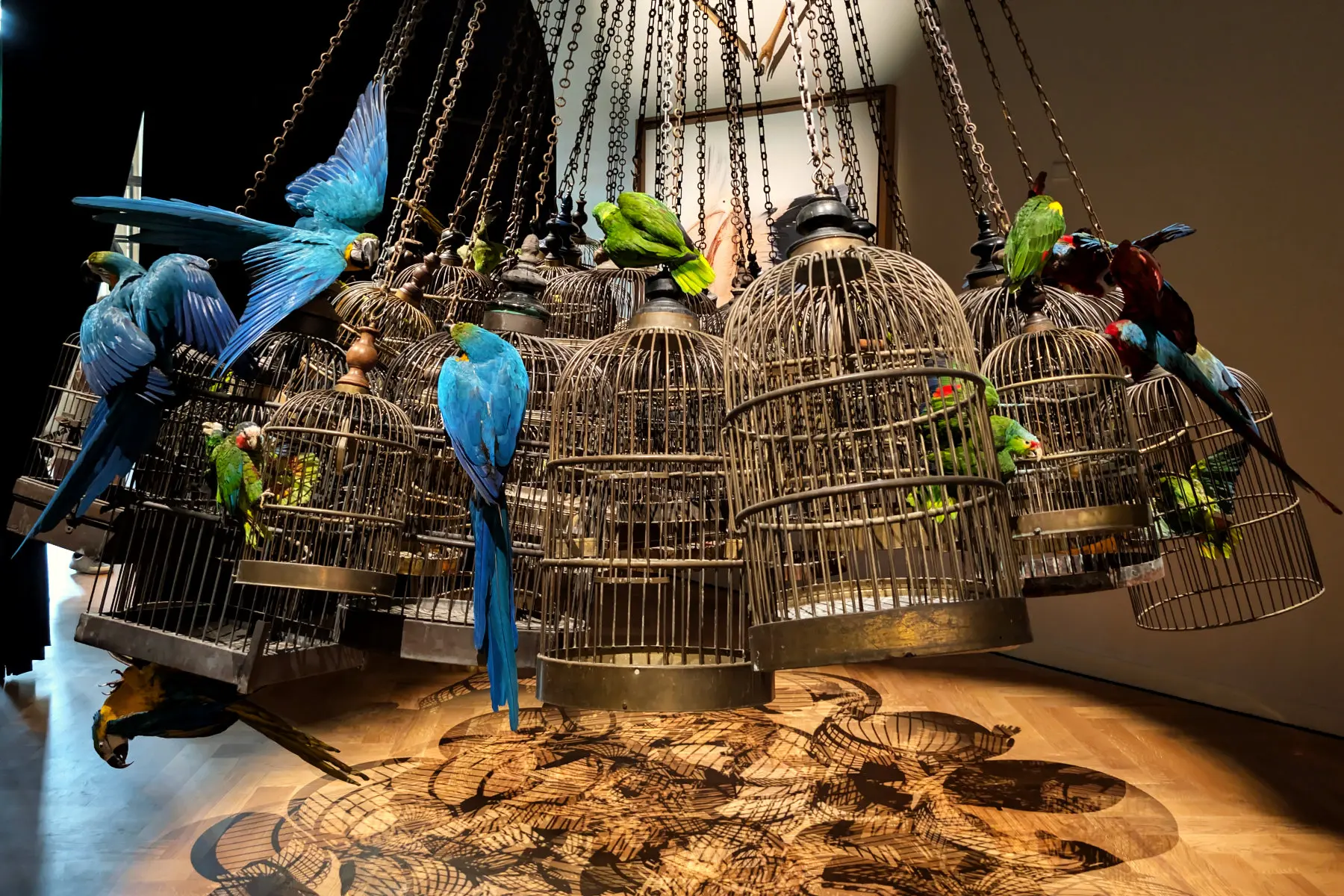
Parrots and Cages Installation
The first thing you see as you step through the curtains.
At the entrance, you are given an audio guide, which leads you through each room and explains the animals, the craft behind the taxidermy and the ethical approach behind the collection. It would have been easy for this place to feel purely visual, but the guide gives it weight. You start looking differently.
Not just at what is there.
But how it got there.
My partner and I found ourselves waiting until the audio finished in each room before talking. Not because we had to, but because there was always something to say after. Something we had noticed. Something we had learned. Something that felt a little stranger than expected.
That is where Art Zoo is at its best.
It asks you to look closely.
Then it makes you sit with it.
Art Zoo does not feel like a normal museum at first. There is no grand entrance, no big institutional feeling, no sense that you are about to walk through something predictable. It feels quieter than that. Dark curtains. Low light. Hidden rooms. The kind of place that makes you lower your voice without really knowing why.
Less museum.
More secret cabinet of curiosities.
The collection is mainly artistic taxidermy, with works by Darwin, Sinke & Van Tongeren. I know taxidermy will not be for everyone. There is always going to be something strange about standing in front of preserved animals and finding beauty in them.
But Art Zoo handles it carefully.
That is what makes it work.
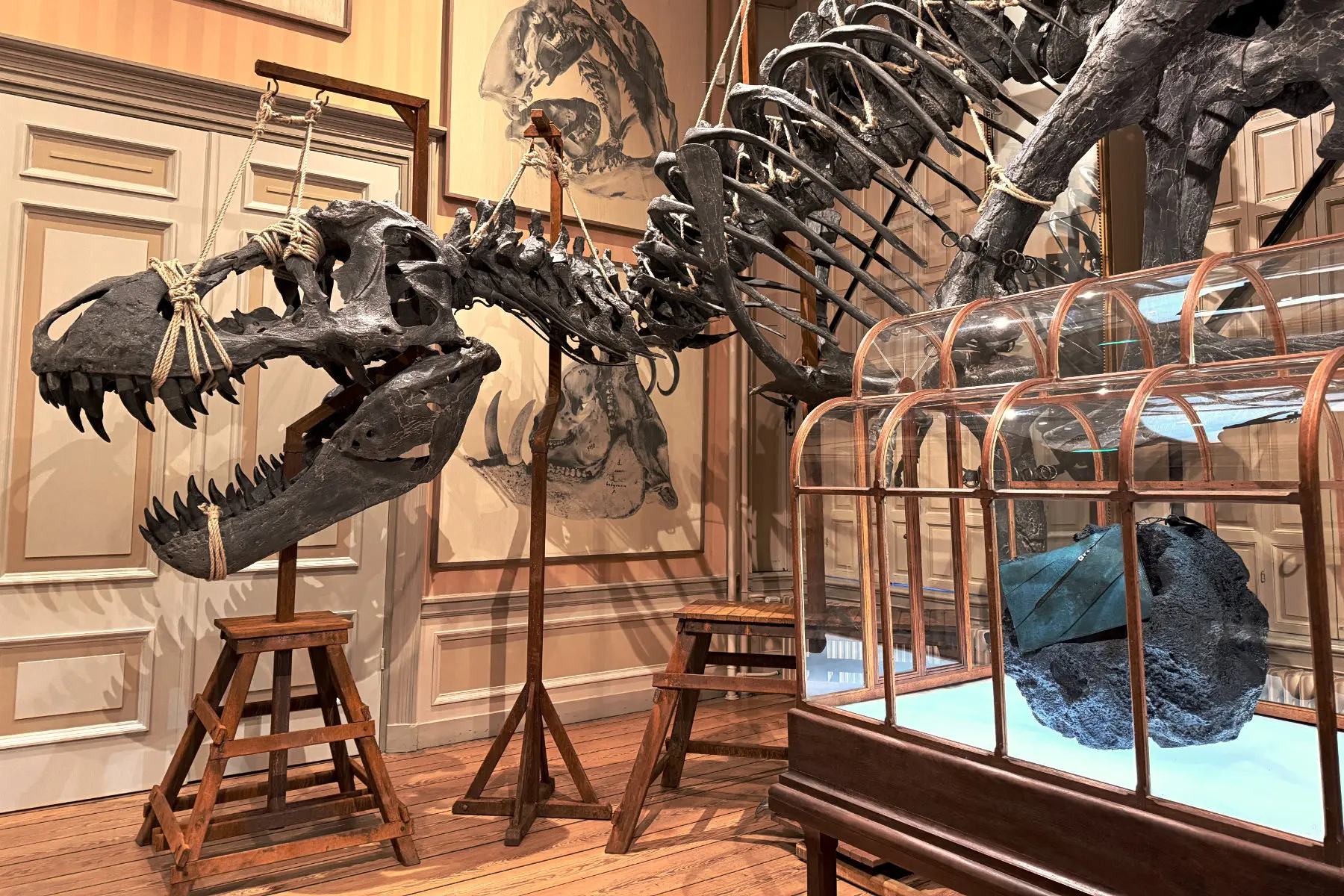
T Rex Cast and Handbag
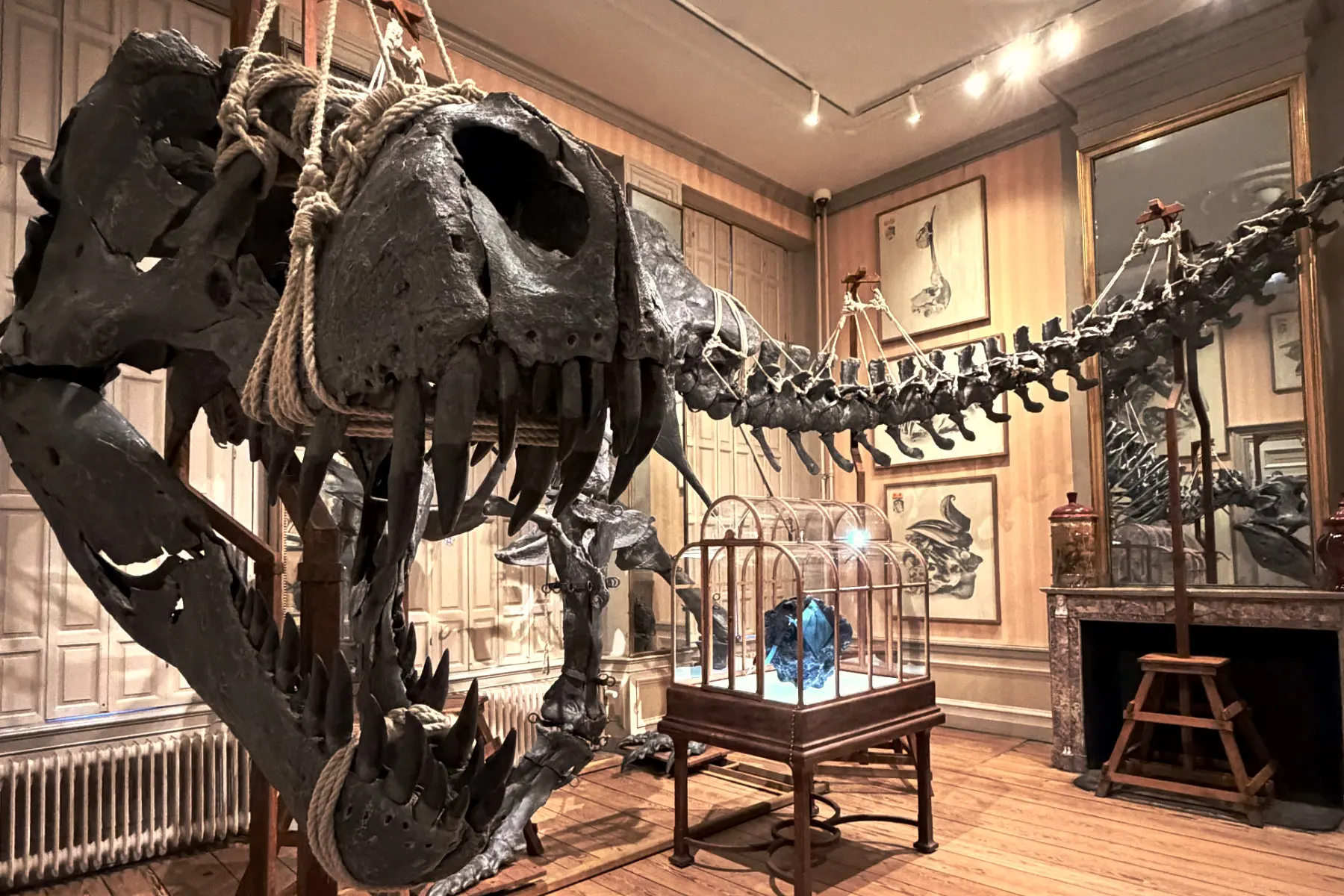
T Rex Cast and Handbag
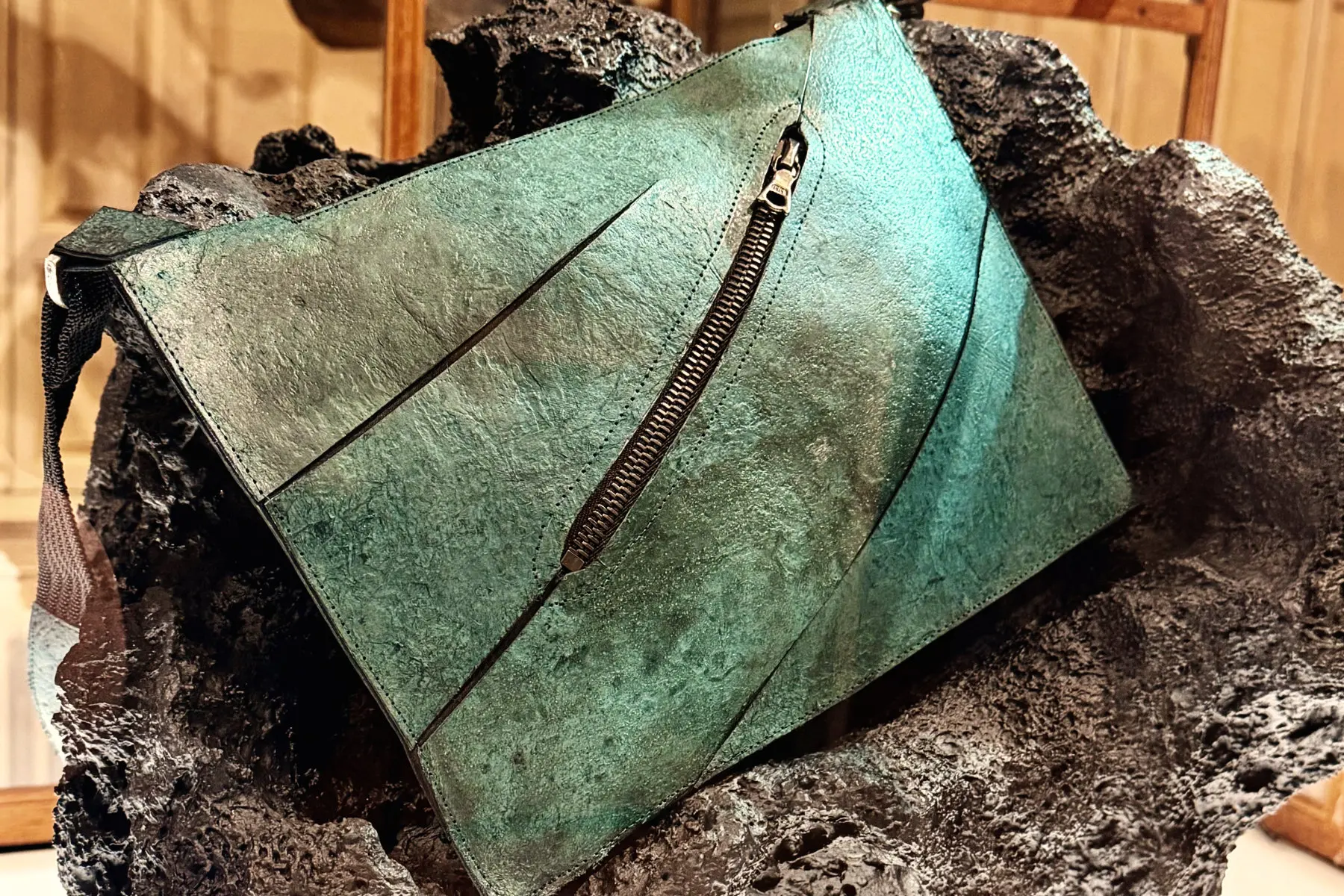
The T Rex Handbag
The object that got us through the door
And then there was the handbag.
A T. rex handbag sounds like something made up to annoy both scientists and fashion people.
But there it was.
Before you even reach it, you are met with a towering T. rex structure, leading you towards the strangest object in the room. A luxury handbag designed by Enfin Levé, made from a lab-grown material inspired by reconstructed T. rex collagen sequences. Scientists used computational biology and AI to create a leather-like material in the lab. Not actual dinosaur skin, obviously. Still strange, though.
Standing there, beside a life-sized T. rex cast acquired from Naturalis Biodiversity Center, it starts to make a weird kind of sense. On its own, the bag could feel like a stunt. Inside Art Zoo, surrounded by preserved animals, fossils and theatrical staging, it becomes something else. Part science experiment, part luxury object, part prehistoric fantasy. After its time here, the one-of-a-kind bag is expected to go to auction, which only adds to the surreal quality of the whole thing.
The sort of thing that should not really exist, but somehow fits perfectly here.
The T. rex handbag is only there until 11 May, but the wider RELICS exhibition continues until 30 November. And while the handbag is the obvious hook, it is not the only reason to go.
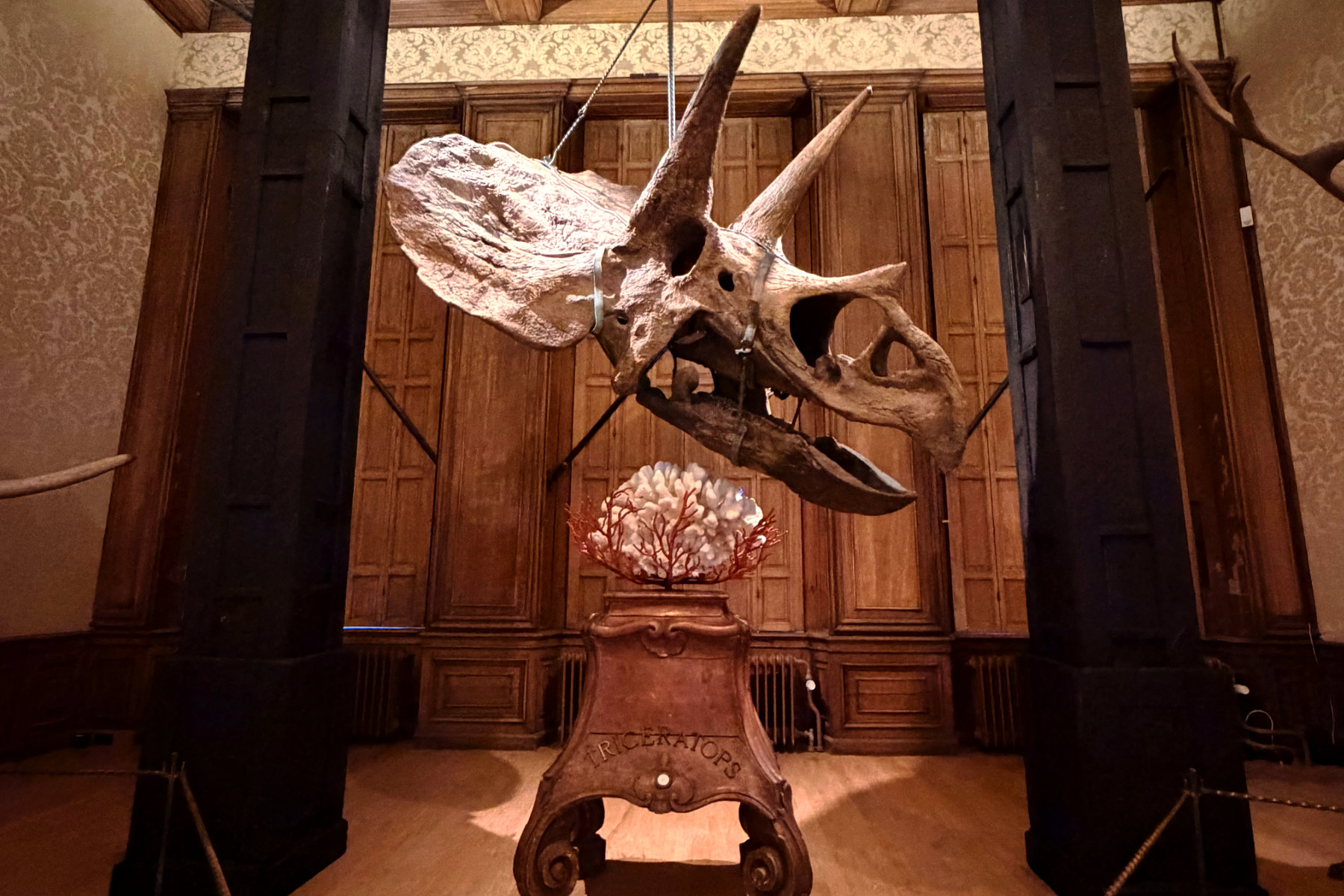
Triceratops Skull Floating Above A Coral Sculpture
The skull rotates above the coral, showing its fossilised detail from every angle.
Around the corner, RELICS opens out into something bigger.
This part of the exhibition takes fossils and remains from creatures that existed millions of years before us and turns them into contemporary artworks. A reimagined fifteen-metre Basilosaurus, around 45 million years old. A Mosasaurus, around 70 million. A Triceratops skull, around 67 million. The kind of pieces that would already be impressive in a natural history museum.
But Art Zoo does not present them like that.
As Iacopo Briano, the exhibition’s curator, puts it: “RELICS is not about revival or scientific reconstruction. RELICS is a matter of beauty.”
And you can see that immediately.
They are surrounded by baroque details, coral, steel, velvet and a painted ceiling by Jacob de Wit. It sounds like too much. It should feel chaotic.
It does not.
It feels staged.
Almost ceremonial.
These are not bones laid out for study. They are relics made strange and elegant, given the kind of presence that makes you slow down in front of them.
That is what Art Zoo does well. It takes something you think you understand and places it somewhere that changes how you look at it.
The exhibition is not trying to bring dinosaurs back to life.
It is doing something quieter than that.
It is asking you to admire what is left behind.
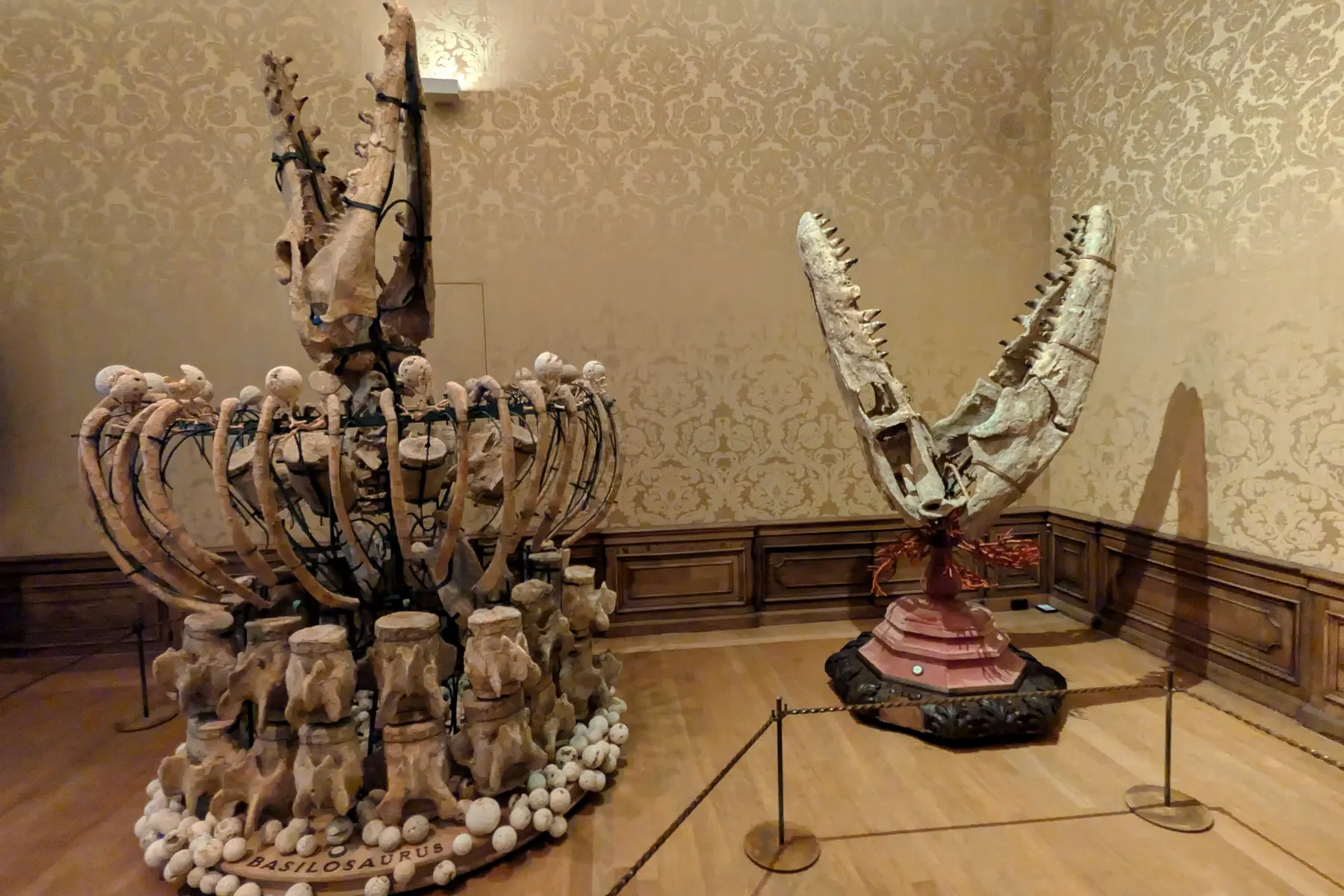
Basilosaurus and Mosasaurus
Displayed with the kind of scale and theatre Art Zoo does so well.
And that feels right for Art Zoo.
Because this is not a big museum.
That is not the point.
It is small, strange, theatrical, and a little unsettling in the best way. The kind of place where every room feels considered, every object feels placed with intent, and every detail asks for a bit more attention than you expected to give.
It is also worth booking ahead. Capacity is limited, and this is not the kind of place you want to leave to chance.
We went for the dinosaur handbag.
We left thinking about everything around it.